Björn Holm
The Leopard (Jo Nesbø Edition)Björn Holm is a veteran forensic technician whose mild, bewildered appearance repeatedly disguises the ability that has made him one of the finest investigators in his field. In the murder investigation, his patient handling of physical evidence brings him into the work of Harry Hole’s team, while his own loyalty and professional obligations become matters of consequence.
Identity and Background
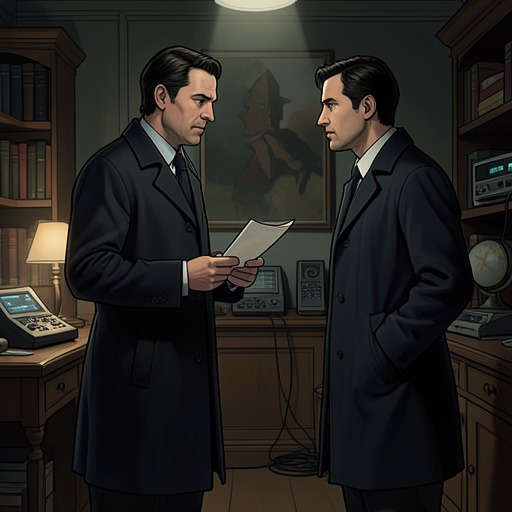
Holm comes from Skreia and is described as a hillbilly, a characterization reinforced by his snakeskin cowboy boots and round face, with slightly protruding eyes that give him a permanently startled look. That appearance has misled more than one investigation leader. The mistake is consequential: Holm is, in fact, the greatest talent in forensic technology since Weber’s heyday. His unshowy manner is not a measure of his competence; it is part of the contrast through which the novel introduces him, setting an apparently simple country technician against the precision and intelligence of his work.
Forensic Work and Professional Judgment
Holm’s expertise is shown in the care with which he reads material traces and in the restraint with which he distinguishes a promising clue from a proven answer. During the investigation into Marit Olsen’s murder, he found tiny mussels on the rope used to kill her. The discovery might help the team, but it also placed him in a professional bind: he had found the mussels while still working for the Norwegian Criminal Investigation Service, and had spoken with a limnologist at the University of Oslo’s biology institute before Beate Lonn transferred him to Harry Hole’s team. Because his report had not yet been written when he changed departments, Holm understood that he now owed the information to Harry, even though the work originated with his former unit.
When the investigators examined a rope at a mountain hut, Holm brought a compact, improvised laboratory with him: a coil of rope, a small backpack, a flashlight fitted with clips for attaching it to a ceiling beam, and a laptop connected to a portable microscope shaped like a hammer. He had saved a photograph on the laptop before the team set out, then used the microscope to take high-resolution images of the rope’s end. His examination identified linden and elm fibers of matching length and thickness, as well as a freshly cut edge. The combination made the rope’s physical construction, and not merely its general appearance, available for comparison.
Holm also gives the investigation a measure of intellectual honesty when prolonged testing produces no answer. After two months of analyzing blood, hair, and nails and scrutinizing images, the team had found no solution to the pattern of 24 holes in the mouth area of the first victims. They had developed 24 theories about how and why the holes had been made, apparently from a single point inside the mouth, without establishing which explanation was right. Marit had a mouth wound too, but Holm distinguished it from that pattern: hers had been made with a knife and was rough, careless, and violent. His account preserves the difference between a shared visual feature and evidence of a shared method.
Institutional Loyalties and the Expanding Investigation
Holm’s move into Harry Hole’s unit places his technical skills inside a contested chain of command. When Beate Lonn tells him that Harry has called and wants him released to the new assignment, Holm’s startled response—he asks what it is for—shows that he has not been managing his own transfer. The reassignment makes him useful to Harry’s investigation, but it also leaves his expertise exposed to competing institutional priorities.
That tension becomes sharper when Holm is absent from a possible crime scene because Mikael Bellman has given him a special assignment. The absence prompts a sarcastic question about whether the task amounts to latrine duty. Later, Holm tells Harry that he suspects Bellman arranged the position to keep him from receiving firsthand information, fearing that Holm would pass it to Harry before Bellman could obtain it. The account is Holm’s suspicion rather than an established explanation, but it clarifies where he believes the struggle over information is being fought: not only over who leads the case, but over who gets to know what has happened.
Holm’s work nevertheless continues to produce evidence with direct consequences for the inquiry. He and Beate examine clothing associated with Adele Vetlesen, including the navy-blue ski trousers she wore at Hävasshütte. Beate identifies a semen stain on the trousers, turning a garment into evidence of intimate contact and sharpening the question of Adele’s meetings with the man she encountered at the hut. Holm later reports the trace to Harry by telephone while Harry is watching a race finish. The discovery gives the investigation a material lead where an account of the relationship alone would not suffice.
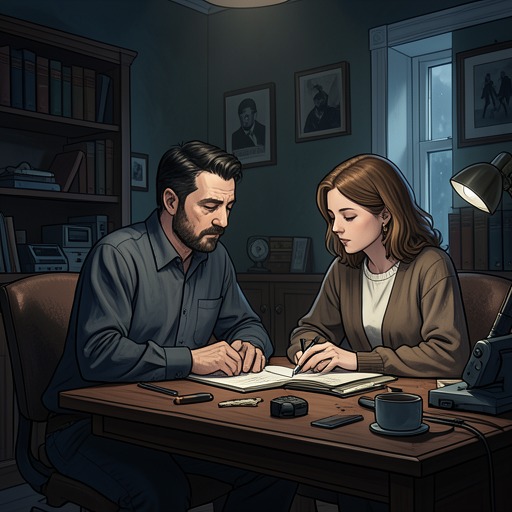
At a search of Tony Leike’s cabin, Holm and the team inspect drawers and cupboards, use special lights to look for blood, and collect fingerprints. A small scanner connected to Holm’s laptop identifies every print found so far as belonging to Tony. The result is an observation about the cabin, not proof that Tony committed the murders: its force lies in placing his traces throughout a space that may be relevant to the case. When Harry shows Holm small pieces of metal wire recovered beneath the sink, Holm has no immediate identification to offer. Later, faced with the question of why Tony would cut off his own middle finger, he voices the puzzle rather than pretending the available evidence has resolved it.
A blow to Holm also enters the relationship between the technician and the investigators. After a meeting, Harry asks whether Holm’s nose still hurts and whether he wants an apology; Holm refuses the offer. The brief exchange establishes an injury and an unresolved personal grievance without displacing the work that continues between them. At the scene of the closing fire at the PSG factory, Holm stands beside Harry under a blanket as firefighters carry out the last buckets of material the factory will ever send out. Their shared presence there links his painstaking evidentiary role to the investigation’s larger, increasingly unstable sequence of discoveries.
The Technician Beyond the Evidence
Holm’s competence coexists with a deeply personal attachment to the ordinary comforts of his life. His beloved Amazon is more than transport: its noisy but remarkably effective heater, worn Skaï seats, dusty parcel shelf, steady engine at about 80 kilometers per hour on a level road, and Hank Williams on the cassette player together give him peace of mind. The detail offers a counterpoint to the clinical exactness of his forensic work. Holm can scrutinize a rope’s fibers and a fingerprint’s ridges, yet the pleasures that restore him are tactile, familiar, and unpretentious.
That country manner is part of how others misread him, but the investigation repeatedly depends on what it conceals. Holm’s startled look and occasional bewilderment do not prevent him from distinguishing a fresh cut from old wear, a trace worth pursuing from a conclusion not yet earned, or a suspicious pattern from a superficial resemblance. Even when he cannot explain the metal fragments beneath Tony Leike’s sink or the apparent decision to sever a finger, he makes the uncertainty visible instead of turning it into false certainty. His value to the team lies not in having an answer for every object, but in knowing how far the evidence allows an answer to go.
Holm’s professional identity also extends into small acts of regard. After the investigation’s upheavals, a message of thanks conveys that Holm had asked for greetings to be passed to a colleague’s wife and praised the meatballs with rutabaga she had served him as the best he had ever eaten. The recollection places him in a domestic exchange beyond laboratories, case files, and jurisdictional conflict. It rounds out the forensic technician as a colleague who remembers hospitality and returns it with courtesy: an unassuming presence whose loyalties and attention to detail are expressed both in the evidence he handles and in the people he does not forget.